Pallet Recycling & Refurbishing
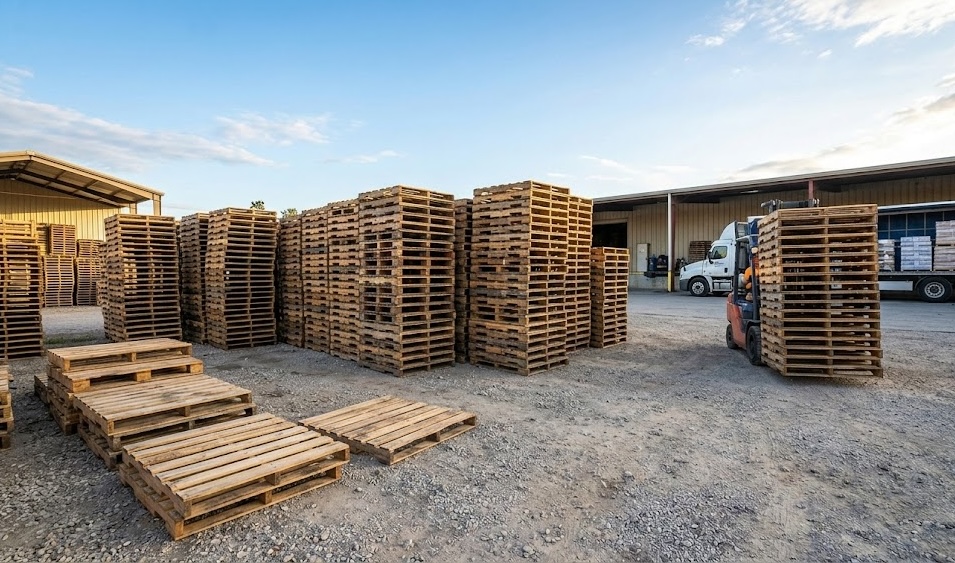
We intercept pallets from the waste stream, repair what we can, and recycle what we cannot. Nothing goes to landfill. Ever. Operating from our Stockton, CA facility with a 99% recycling rate.
Request a Quote
From Waste to Value in 7 Steps
Every pallet that enters our facility follows a meticulous seven-step process designed to maximize reuse, minimize waste, and deliver consistent quality back to the market. Our process is audited regularly and documented for full traceability from intake to final disposition.
Collection & Intake
We pick up used pallets from your location or accept drop-offs at our 2622 Wigwam Dr, Stockton facility. Every batch is logged into our tracking system, weighed on our certified platform scale, and photographed for documentation. We collect pallets in any condition -- from pristine surplus to severely damaged scrap.
- Free pickup within Central Valley and California coverage area
- Drop-off accepted Monday through Saturday, 6 AM to 5 PM
- Digital intake records with batch tracking numbers
- Platform scale weighing for accurate material accounting
- Immediate sorting into repair vs. recycling streams
Inspection & Grading
Every pallet is inspected by trained technicians using our standardized 12-point grading system. We assess structural integrity of stringers and blocks, board condition and thickness, nail and fastener security, dimensional accuracy, and contamination levels including chemicals, mold, and pest activity.
- 12-point structural integrity inspection checklist
- Grade A, B, C, and Scrap classification with documentation
- Contamination screening for chemicals, mold, and pests
- Dimensional verification with calipers and measuring tools
- Moisture content testing on suspect units
Sorting & Routing
After inspection, pallets are sorted into distinct processing streams. Repairable pallets move to the refurbishment line. Pallets with recoverable lumber are disassembled for board stock. Pallets beyond repair are routed to our grinding and material recovery operation. Nothing is left unaccounted for.
- Three-stream sorting: repair, disassemble, grind
- Lumber quality assessment for board recovery potential
- Metal fastener separation for recycling
- Contaminated material isolated for proper disposal
- Digital tracking updated at every routing decision
Repair & Refurbishment
Pallets that pass the repair threshold go to our skilled refurbishment team. Broken boards are replaced with dimensionally matched lumber sourced from our own disassembly operation. Loose nails are re-driven or replaced with ring-shank fasteners for superior holding power. Cracked stringers are reinforced with companion boards or replaced entirely.
- Board replacement with species-matched lumber
- Re-nailing with 2.5-inch ring-shank pallet nails
- Stringer repair with bolted companion boards
- Block replacement on block-style pallets
- Post-repair quality check before re-grading
Treatment & Certification
Refurbished pallets undergo heat treatment where required, meeting ISPM-15 international standards. Our certified kiln reaches and maintains the required 56 degrees Celsius core temperature for a minimum of 30 minutes. Every treated pallet is stamped with the official IPPC mark for international acceptance.
- ISPM-15 heat treatment at 56C / 132.8F core temperature
- Official IPPC certification stamp applied and documented
- Full documentation package for customs and export compliance
- Batch tracking with kiln temperature records on file
- Same-day treatment available for urgent export orders
Material Recovery & Grinding
Pallets that cannot be repaired are fully dismantled. Usable lumber is sorted by species, dimension, and condition for board replacement stock. Remaining wood is fed into our industrial grinder to produce mulch, animal bedding, and biomass fuel. Metal fasteners are magnetically separated and sent to metal recyclers.
- Lumber recovery for repair operations -- species-sorted
- Industrial grinding to uniform chip size for mulch
- Colored mulch production for landscape supply
- Animal bedding grade material for equestrian and agricultural use
- Biomass fuel chips for energy generation facilities
Quality Final Check & Distribution
Every refurbished pallet receives a final quality inspection and grade stamp before entering our sales inventory. Mulch, bedding, and biomass products are tested for quality standards before distribution. Complete records are maintained for every pallet from intake to final disposition, giving clients full traceability.
- Final load-bearing test on refurbished pallets
- Grade stamp applied with batch and date codes
- Mulch quality testing for consistency and cleanliness
- Complete lifecycle documentation available to clients
- Sustainability certificates generated per client account
What We Recycle
We accept virtually every type of pallet and pallet material. If it is made of wood, plastic, or metal, we can recycle it. Here is a detailed breakdown of accepted material categories.
Wood Pallets
- Hardwood pallets (oak, maple, birch)
- Softwood pallets (pine, spruce, fir)
- Stringer and block construction
- Two-way and four-way entry
- Standard GMA and custom sizes
- Heat-treated and non-treated
- Broken, damaged, and scrap wood
- Painted or stamped pallets
Plastic Pallets
- HDPE and polypropylene pallets
- Nestable and stackable designs
- Export and one-way pallets
- Rackable plastic pallets
- Broken and damaged units
- Food-grade and industrial-grade
- Thermoformed lightweight pallets
- Injection-molded heavy-duty units
Metal & Fasteners
- Steel and aluminum pallets
- Metal pallet collars and lids
- Nails, screws, and staples
- Banding and strapping materials
- Steel reinforcement plates
- Hinge pins and corner hardware
- Wire mesh deck panels
- Forklift entry reinforcement bars
Packaging & Misc
- Crating and skid materials
- Dunnage and packaging lumber
- Pallet wrap and stretch film
- Cardboard slip sheets
- Foam and corrugated inserts
- Wooden crate panels and tops
- Plywood sheets and offcuts
- Sawdust and wood shavings
What Recycling Really Saves
Every pallet we recycle instead of sending to a landfill has a measurable positive impact on the environment. Here is what the numbers look like at various scales. These figures are based on EPA and USDA data for average wood pallet material content.
| Metric | Per 100 Pallets | Per 500 Pallets | Per 1,000 Pallets | Per 10,000 Pallets |
|---|---|---|---|---|
| Trees Saved | ~50 | ~250 | ~500 | ~5,000 |
| Lumber Preserved (board ft) | 3,300 | 16,500 | 33,000 | 330,000 |
| CO2 Emissions Avoided (lbs) | 2,800 | 14,000 | 28,000 | 280,000 |
| Landfill Space Saved (cu yd) | 12 | 60 | 120 | 1,200 |
| Water Saved (gallons) | 2,700 | 13,500 | 27,000 | 270,000 |
| Energy Saved (kWh) | 680 | 3,400 | 6,800 | 68,000 |
What Happens to Each Part of a Pallet
Reusable Boards
Sorted by species and dimension, these boards become replacement stock for our refurbishment operation, extending the life of other pallets.
Mulch & Bedding
Wood that cannot be reused as lumber is ground into landscape mulch, colored mulch products, and animal bedding for equestrian and farm use.
Biomass Fuel
Fine wood particles and sawdust are compressed into biomass fuel pellets or delivered to energy generation facilities in the Central Valley.
Metal Recycling
Nails, staples, and metal fasteners are magnetically separated during grinding and sent to regional metal recyclers for smelting.
Recycling vs. Landfill
An estimated 420 million pallets are discarded in the US every year. Here is how recycling compares to sending them to the landfill.
Landfill Disposal
- Occupies valuable landfill space -- pallets represent ~8% of all landfill waste by volume
- Produces methane as wood decomposes anaerobically, contributing to greenhouse gas emissions
- Wastes 33 board feet of usable lumber per standard pallet
- Disposal fees of $35-$75 per ton add cost to your operations
- Nails and fasteners leach iron and other metals into groundwater
- Zero material recovery -- complete resource destruction
- No sustainability reporting value for ESG or green certifications
Stockton Pallet Recycling
- 99% material recovery rate -- virtually nothing reaches a landfill
- Reduces carbon emissions by 28 lbs CO2 equivalent per pallet recycled
- Recovers 33 board feet of usable lumber per pallet for reuse or mulch
- Free pickup for qualifying volumes -- no disposal fees, often a payment to you
- Metal fasteners magnetically separated and sent to certified metal recyclers
- Creates mulch, animal bedding, and biomass fuel from non-reusable wood
- Full sustainability reporting with certificates for ESG, LEED, and green audits
Extend the Life of Every Pallet
Our refurbishing operation turns damaged pallets into reliable, market-ready products. Each repaired pallet is tested to meet the same load-bearing and structural standards as a new unit, at a fraction of the cost and environmental impact. Our technicians use specialized tools and techniques honed through years of experience to maximize repair success rates.
Board Replacement
Cracked or missing boards replaced with dimensionally matched, species-appropriate lumber from our recovery operation.
Stringer Repair
Broken stringers reinforced with bolted companion boards or replaced entirely. Notched stringers repaired to original strength.
Re-Nailing
Loose fasteners re-driven and supplemented with 2.5-inch ring-shank nails for 40% better holding power than standard smooth nails.
Heat Treatment
ISPM-15 compliant heat treatment for international shipment. Kiln temperature and core probe data logged for every batch.
Custom Downsizing
Standard pallets cut down and rebuilt to meet non-standard dimensions. Ideal for converting surplus 48x40 into smaller specialty sizes.
Quality Stamping
Each refurbished pallet receives a quality grade stamp with date code and batch number for full traceability.
Block Replacement
Damaged or crushed blocks on block-style pallets replaced with matching hardwood blocks, preserving four-way entry capability.
Lead Board Reinforcement
High-wear lead boards reinforced with additional nails or replaced with thicker gauge lumber for extended service life.
Refurbishing by the Numbers
Our track record demonstrates the scale and impact of our refurbishing operations at our Stockton facility.
The Planet Wins with Every Pallet
Each year, an estimated 420 million pallets are discarded in the US alone. Our recycling operations help reverse that trend, one pallet at a time.
Each recycled pallet saves roughly half a tree from being harvested for new lumber.
Recycling pallets instead of manufacturing new ones dramatically reduces carbon emissions.
Our zero-waste commitment means every single pallet component is reused or recycled.
Wood, metal fasteners, and plastic components are all separated and recycled individually.
Our Zero-Waste Commitment
Sustainability is not a marketing angle for us -- it is the foundation of everything we do. From solar panels powering our facility to biodiesel in our delivery fleet, we invest in reducing our environmental footprint at every stage of operations. We partner with local environmental organizations, participate in tree-planting initiatives, and publish annual sustainability reports for full transparency. Every client receives a detailed sustainability certificate showing the measurable impact of their recycling partnership.
Recycling FAQs
How our zero-landfill recycling program works, what we accept, and how quickly we pick up.
What types of pallets do you accept for recycling?
We accept wood, plastic, and metal pallets in any condition. Broken pallets are repaired or ground for reuse, never landfilled.
Do you provide certificates of destruction or recycling?
Yes. We can issue recycling receipts, diversion totals, and chain-of-custody documentation for audits and ESG reporting.
Is there a fee to drop off damaged pallets?
For qualifying volumes, drop-off is free. Otherwise, we can schedule affordable pickup based on location and load size.
How quickly can you remove a backlog of scrap pallets?
Most clear-outs are scheduled within 48 hours in the Central Valley; large projects can be routed within 3–5 business days.
What happens to pallets that cannot be repaired?
They are mulched, turned into animal bedding, biomass fuel, or particle board—maintaining a 99% recycling rate.
Have Pallets to Recycle?
Do not let old pallets pile up and go to waste. Contact us for free pickup of any quantity. We will sort, recycle, and refurbish -- and pay you for reusable inventory. Email info@stocktonpallet.com or use the quote form to get started.