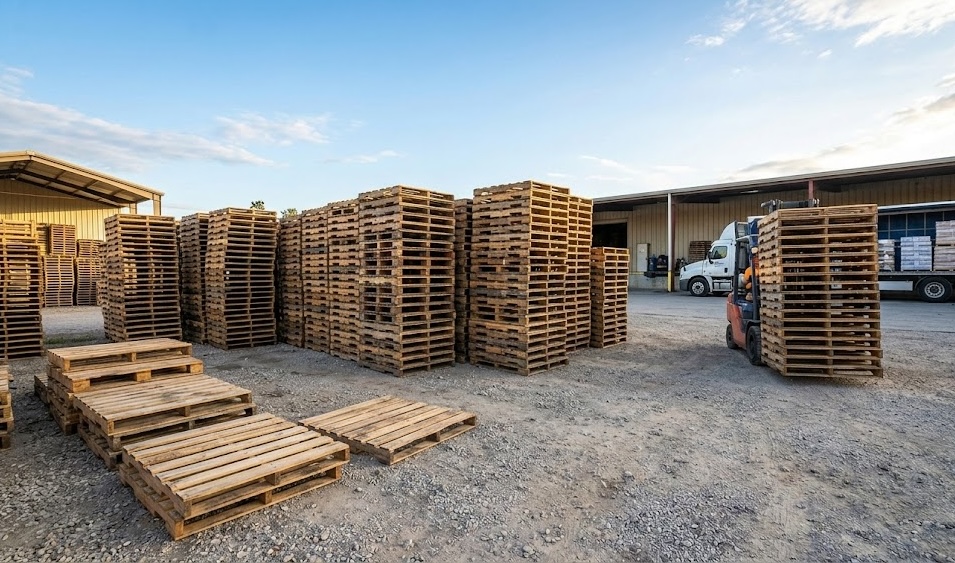
Wood Pallets
The most popular pallet material on Earth — and the most recyclable. We carry a full range of used wood pallets inspected, graded, and ready to ship from our Stockton, CA yard.
Request a Quote
Wood Pallet Styles
Different applications call for different construction. We stock the three primary wood pallet types to cover every use case — from light-duty shipping to heavy automated racking.
Stringer Pallets
The workhorse of the pallet world. Built with two or three parallel stringers (long boards running the length of the pallet) that support the deck boards. Stringer pallets are the most common type in North America, accounting for roughly 80% of all wood pallets produced. Their simple design makes them affordable to manufacture, easy to repair, and widely available in used condition.
- Two-way or partial four-way entry
- Lightweight and cost-effective
- Easy to repair and refurbish
- Standard 48x40 and 15+ other sizes
- Ideal for conveyor systems
- Notchable for four-way fork entry
- 2,200-2,500 lb dynamic load capacity
- From $2.50/pallet (Grade C)
Block Pallets
Built with solid wood blocks between the top and bottom deck boards, creating a stronger, more rigid structure. Block pallets offer true four-way forklift entry, making them the go-to choice for automated warehouses and international shipping. They meet GMA (Grocery Manufacturers Association) and EPAL (European Pallet Association) standards, and are the preferred pallet for racking applications.
- True four-way forklift entry
- Higher load capacity than stringer
- GMA / EPAL compatible
- Better for automated systems
- Superior for racking applications
- Nine-block standard construction
- 2,500-3,000 lb dynamic load capacity
- From $3.50/pallet (Grade C)
Custom Pallets
When standard won't cut it, we build to your specifications. Odd dimensions, special load ratings, unique entry configurations — our team can source or build exactly what you need from reclaimed lumber. Custom pallets are common in agriculture, manufacturing, and military/defense applications where non-standard products require non-standard shipping solutions.
- Any dimension up to 72x72
- Engineered load ratings
- Specialty wood species available
- Heat treatment & stamping
- Volume discounts for large runs
- CAD design assistance available
- Prototype-to-production workflow
- Pricing based on specifications
Complete Size Guide
We stock 15+ standard sizes with full specifications. Every size is available in stringer and block configurations, and in all three quality grades. Can't find what you need? We source custom dimensions within 3-5 business days.
| Size (in) | Common Name | Primary Use | Pallet Wt. | Dynamic Load | Static Load | Racking Load | Avail. |
|---|---|---|---|---|---|---|---|
| 48 x 40 | GMA / Grocery | General freight, retail, grocery | 33-48 lbs | 2,800 lbs | 7,500 lbs | 2,500 lbs | High |
| 42 x 42 | Telecom / Paint | Telecommunications, paint | 29-40 lbs | 2,500 lbs | 6,000 lbs | 2,200 lbs | High |
| 48 x 48 | Drum Pallet | Drums, barrels, bulk | 38-55 lbs | 3,000 lbs | 8,000 lbs | 2,500 lbs | High |
| 48 x 42 | Chemical / Beverage | Chemical, beverage, shingles | 35-50 lbs | 2,700 lbs | 7,000 lbs | 2,300 lbs | Medium |
| 40 x 40 | Dairy Pallet | Dairy, produce, small goods | 28-38 lbs | 2,500 lbs | 6,000 lbs | 2,000 lbs | Medium |
| 48 x 36 | Beverage | Beverage, shingles, paper | 32-45 lbs | 2,500 lbs | 6,500 lbs | 2,200 lbs | Medium |
| 36 x 36 | Small Goods | Electronics, parts, lightweight | 22-32 lbs | 2,000 lbs | 5,000 lbs | 1,800 lbs | Medium |
| 48 x 20 | Half Pallet | Retail display, end-caps | 18-25 lbs | 1,500 lbs | 4,000 lbs | N/A | Low |
| 48 x 24 | Narrow Pallet | Tight aisles, vending | 20-28 lbs | 1,800 lbs | 4,500 lbs | 1,200 lbs | Low |
| 60 x 48 | Oversized | Large equipment, HVAC | 45-65 lbs | 3,500 lbs | 10,000 lbs | 3,000 lbs | Low |
| 72 x 48 | Industrial | Heavy mfg, machinery | 55-80 lbs | 4,000 lbs | 12,000 lbs | 3,500 lbs | Low |
| 44 x 44 | Military / Drum | Military, 55-gal drums | 32-42 lbs | 2,500 lbs | 6,500 lbs | 2,200 lbs | Low |
| 36 x 48 | Reversed GMA | Specialty applications | 33-48 lbs | 2,500 lbs | 7,000 lbs | 2,200 lbs | Low |
| 40 x 48 | Chemical | Chemical industry standard | 33-48 lbs | 2,800 lbs | 7,500 lbs | 2,500 lbs | Medium |
| Custom | Made to Spec | Any specialty application | Varies | Engineered | Engineered | Engineered | On Request |
All sizes available in stringer and block configurations. Load capacities shown are for Grade A stringer pallets — block pallets have 10-20% higher capacity. Pricing varies by grade and quantity. View our complete size guide
Wood Species Comparison
Not all wood pallets are created equal. The species of wood used in pallet construction dramatically affects strength, weight, durability, and cost. Here's how the four most common species compare.
| Property | Southern Yellow Pine | Oak (Red / White) | Hard Maple | Spruce / SPF |
|---|---|---|---|---|
| Hardness (Janka lbs) | 690 - 870 | 1,220 - 1,360 | 1,450 | 400 - 510 |
| Density (lb/ft3) | 35 - 41 | 44 - 56 | 44 | 25 - 28 |
| Bending Strength (psi) | 10,000 - 13,000 | 10,300 - 14,300 | 15,800 | 7,400 - 9,400 |
| Stiffness (MOE psi) | 1.6 - 1.9M | 1.5 - 1.8M | 1.83M | 1.3 - 1.5M |
| Pallet Weight (48x40) | 35 - 42 lbs | 45 - 55 lbs | 42 - 50 lbs | 28 - 35 lbs |
| Nail Holding Power | Excellent | Excellent | Superior | Good |
| Rot Resistance | Moderate (treat.) | Good (white oak) | Low | Low |
| Moisture Content | Moderate | High (slow dry) | Moderate | Low |
| Cost (relative) | $$ | $$$ | $$$$ | $ |
| Availability (CA) | High | Medium | Low | High |
| Best For | All-purpose, export | Heavy loads, durability | Extreme strength | Lightweight, air freight |
| ISPM-15 Treatable | Yes | Yes | Yes | Yes |
Southern Yellow Pine
The dominant pallet wood in the US. Excellent balance of strength, weight, nail-holding, and cost. Pine pallets treat well under ISPM-15 and are available in large quantities.
Oak
Premium hardwood with exceptional strength and durability. Heavier than pine, which increases shipping weight but provides superior load capacity. White oak has natural rot resistance.
Hard Maple
The hardest common pallet wood. Exceptional bending strength and abrasion resistance. Used for specialty pallets carrying extremely heavy or abrasive loads. Less common and more expensive.
Spruce / SPF
Spruce-Pine-Fir blend is the lightest common pallet wood. Ideal when shipping weight matters — air freight, parcel shipping. Lower load capacity but significantly lighter.
Wood Pallet Grades
Our three-tier grading system ensures transparency. You choose the quality level that matches your needs and budget. Each grade is inspected against documented standards.
Premium Grade
- Like-new appearance, minimal wear
- No cracked, broken, or missing boards
- No protruding nails or staples
- Clean — no chemical stains or odors
- Full rated load capacity (100%)
- Export-ready with ISPM-15 option
- Passes automated system tolerance checks
- No mold, mildew, or biological contamination
Standard Grade
- Light cosmetic wear — fully functional
- All boards intact and fastened
- Minor staining or scuff marks okay
- No structural defects
- Full rated load capacity (90-100%)
- Most popular grade we sell
- Suitable for domestic and some export
- Compatible with all standard equipment
Economy Grade
- Heavier cosmetic wear
- May include repaired boards
- Visible staining allowed
- Structurally functional
- Suitable for one-way shipping
- Bulk discounts available
- Load capacity 75-90% of original
- Some board replacements may be present
Load Capacity by Size & Type
Understanding the three types of pallet load ratings is critical for safe shipping and storage. Dynamic load is what a pallet can carry while being moved by a forklift. Static load is what it can support sitting on a flat surface. Racking load is what it can hold when spanning between two rack beams.
| Size | Stringer Pallet | Block Pallet | ||
|---|---|---|---|---|
| Dynamic | Static / Racking | Dynamic | Static / Racking | |
| 48 x 40 | 2,800 lbs | 7,500 / 2,500 lbs | 3,200 lbs | 8,500 / 2,800 lbs |
| 42 x 42 | 2,500 lbs | 6,000 / 2,200 lbs | 2,800 lbs | 7,000 / 2,500 lbs |
| 48 x 48 | 3,000 lbs | 8,000 / 2,500 lbs | 3,500 lbs | 9,500 / 3,000 lbs |
| 48 x 42 | 2,700 lbs | 7,000 / 2,300 lbs | 3,100 lbs | 8,000 / 2,600 lbs |
| 40 x 40 | 2,500 lbs | 6,000 / 2,000 lbs | 2,800 lbs | 7,000 / 2,300 lbs |
| 48 x 36 | 2,500 lbs | 6,500 / 2,200 lbs | 2,800 lbs | 7,500 / 2,500 lbs |
| 36 x 36 | 2,000 lbs | 5,000 / 1,800 lbs | 2,300 lbs | 5,800 / 2,000 lbs |
| 60 x 48 | 3,500 lbs | 10,000 / 3,000 lbs | 4,000 lbs | 12,000 / 3,500 lbs |
| 72 x 48 | 4,000 lbs | 12,000 / 3,500 lbs | 4,500 lbs | 14,000 / 4,000 lbs |
Dynamic Load
The max weight a pallet can carry while being moved by a forklift or pallet jack. This is the most common rating used in shipping and receiving operations.
Static Load
The max weight a pallet can support sitting on a flat, level surface without movement. Typically 2.5-3x the dynamic load rating. Used for floor stacking operations.
Racking Load
The max weight a pallet can hold when spanning between two rack beams with no center support. The most demanding load scenario — always check this rating for rack storage.
Applications by Industry
Different industries have different pallet requirements. Here's our specific recommendation for each — the right size, type, grade, and treatment for your application.
Grocery & Retail
The 48x40 is the grocery industry standard — fits perfectly in truck trailers and standard racking. Grade A for retail display, Grade B for back-of-house. ISPM-15 for imported goods.
Manufacturing
Manufacturing often requires heavier-duty pallets and non-standard sizes. Block pallets for four-way access. Grade C is ideal for in-plant transfers where appearance does not matter.
Warehousing & 3PL
3PL operations need high-volume, consistent pallets at the best price. We supply mixed-grade loads tailored to each client within your facility. Recurring delivery programs available.
Agriculture & Produce
Harvest season demands high volume at low cost. Grade C is perfect for one-way produce shipments. We offer seasonal supply contracts with locked-in pricing for Central Valley growers.
Construction
Concrete, brick, and building materials need tough pallets at the lowest price. Grade C with extra reinforcement is ideal. Oversized 60x48 and 72x48 for large-format materials.
Automotive
Automotive supply chains demand precise dimensions for automated assembly lines. Block pallets for four-way fork entry. Grade A ensures consistent dimensions for AGV compatibility.
Pharmaceuticals
Pharmaceutical shipping requires clean, Grade A pallets with full ISPM-15 compliance. Heat-treated, debarked, and inspected to the highest standard. Consider plastic if cleanroom contact is needed.
E-Commerce & Fulfillment
Fulfillment centers burn through pallets fast. Grade B stringer pallets offer the best cost-per-shipment ratio. We supply recurring weekly loads to keep your operation running without interruption.
Wine & Spirits
Central Valley wineries and distilleries need clean pallets that do not impart odor or contamination. Grade A block pallets in oak or pine. ISPM-15 for export shipments to international markets.
Cold Storage & Freezer
Moisture management is critical in cold storage. Kiln-dried wood pallets with low moisture content prevent mold growth in refrigerated environments. Block pallets for racking stability.
ISPM-15 Certified
Shipping internationally? ISPM-15 (International Standards for Phytosanitary Measures No. 15) requires that all wood packaging materials used in international trade be treated to eliminate pests. We offer heat-treated pallets stamped with the official IPPC mark.
Countries Requiring ISPM-15
All EU member states, China, Australia, New Zealand, Canada, Mexico, Japan, South Korea, India, Brazil, and virtually every major trading partner. If you are shipping wood pallets across any international border, ISPM-15 compliance is almost certainly required. Non-compliance can result in rejected shipments, fines, and quarantine of your goods at the port of entry.
ISPM-15 Mark
International Phytosanitary Standard
What the Mark Means
- IPPC
- International Plant Protection Convention logo
- XX
- ISO country code (US for United States)
- 000
- Producer / treatment provider registration number
- HT
- Heat Treatment — core temp 56 C for 30 min
- DB
- Debarked — all bark removed per standard
ISPM-15 Compliance Checklist
Maintenance & Care Tips
Proper handling and storage can double or triple the lifespan of your wood pallets. Follow these guidelines to maximize the value of your pallet investment.
Store Under Cover
Rain and UV exposure are the top causes of premature pallet degradation. Store unused pallets under a roof, tarp, or covered structure whenever possible. This alone can extend pallet life by 50%.
Stack on Level Ground
Uneven surfaces cause warping and stress fractures. Always stack pallets on flat, level ground. Limit stack height to 15-20 pallets to prevent bottom-pallet compression damage.
Inspect Before Use
A quick visual check takes 10 seconds and prevents accidents. Look for cracked boards, protruding nails, and broken stringers/blocks. Remove damaged pallets from service immediately.
Avoid Overloading
Never exceed the rated load capacity. Overloading is the #1 cause of pallet failure and workplace injuries. Distribute weight evenly across the deck — concentrated point loads cause board breaks.
Repair Promptly
A loose board or protruding nail is a quick fix. Left unaddressed, minor damage cascades into structural failure. Hammer loose nails, replace broken boards, and keep pallets in service longer.
Rotate Stock (FIFO)
Use a first-in-first-out rotation for your pallet inventory. This ensures older pallets get used before new arrivals, preventing long-term storage degradation from sitting unused for months.
Keep Pallets Dry
Moisture causes mold growth, increases weight, and weakens wood fibers. If pallets get wet, separate them and allow air circulation for drying. Never shrink-wrap wet pallets — trapped moisture accelerates rot.
Use Proper Fork Equipment
Ensure forklift forks fully enter the pallet before lifting. Short-forking causes deck board damage. Center the load on the forks and lift smoothly — jerky handling cracks boards and loosens fasteners.
Return End-of-Life Pallets
When pallets reach the end of their useful life, return them to Stockton Pallet Co. through our buyback program. We repair what we can and recycle the rest — nothing goes to landfill.
Environmental Lifecycle Data
Wood pallets are the most environmentally friendly pallet option when properly managed through a reuse-repair-recycle lifecycle. Here's the environmental impact data that matters for your ESG reporting.
The Wood Pallet Lifecycle
Harvest
Sustainably managed forestry — for every tree harvested, 3-5 are planted.
Manufacture
Raw lumber is cut, assembled, and fastened into pallet structures.
First Use
Pallets enter the supply chain carrying products from A to B.
Reuse (5-15x)
Used pallets are collected, inspected, and resold — this is where we come in.
Repair
Damaged pallets get new boards, nails, and structural fixes to extend life.
Recycle
End-of-life pallets become mulch, animal bedding, biofuel, or particle board.
Recycled Wood Products
When a wood pallet reaches the absolute end of its useful life, the material is never wasted. Here's where retired pallet wood goes:
- Landscape mulch and ground cover (40%)
- Animal bedding and equine footing (20%)
- Biomass fuel for energy generation (15%)
- Particle board and engineered wood products (15%)
- Compost and soil amendment (10%)
ESG Documentation Available
We provide documentation for your sustainability reporting:
- Number of pallets reused (units diverted from waste stream)
- Estimated board feet of lumber saved
- Estimated CO2 emissions avoided (metric tons)
- Landfill diversion tonnage
- Recycled material destination breakdown
- Chain of custody documentation
Why Wood Pallets?
Wood remains the dominant pallet material worldwide for good reason. Here's why over 90% of pallets in the US are made of wood.
Most Affordable Option
Used wood pallets are the most cost-effective pallet solution available. At 40-60% less than new pallets, the economics are unbeatable for most operations. A Grade B 48x40 costs just $4.50-$6.00.
Easily Repaired
Broken board? We replace it. Loose nail? We fix it. Wood pallets can be repaired and returned to service quickly, extending their useful life by years. Repairs cost 30-50% less than replacement.
100% Recyclable
At end of life, wood pallets are ground into mulch, animal bedding, biofuel, or particle board. Nothing goes to waste in our operation. 95%+ of pallet wood is recovered and repurposed.
High Load Capacity
Standard wood pallets support 2,500-2,800 lbs in dynamic use and up to 7,500 lbs in static racking. Block pallets handle even more. Wood provides exceptional strength-to-cost ratio.
Renewable Resource
Wood is the only pallet material that grows on trees — literally. And reusing pallets means fewer trees need to be harvested. Sustainable forestry ensures a perpetual supply.
Universal Compatibility
Wood pallets work with every type of forklift, pallet jack, conveyor, and racking system. No special equipment needed. They are the universal standard that the entire supply chain is built around.