Sustainability Commitment
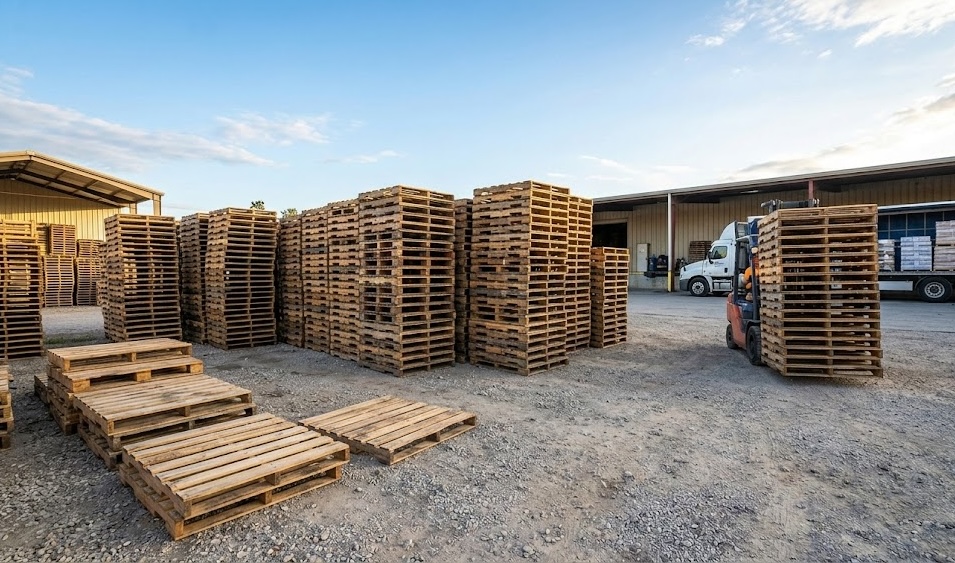
Every pallet we save from a landfill is a victory for the planet. Sustainability is not just a value we hold — it is the foundation of everything we do at our facility in Stockton, CA.
Request a Quote
Environmental Impact by the Numbers
We measure what matters. These figures represent our annual contribution to a healthier planet through responsible pallet management. Every number is tracked through our internal material flow accounting system and verified through our operational records. Sustainability without measurement is just marketing. We believe in transparency and accountability.
Pallets diverted from landfills every single month at our Stockton facility
Trees saved from logging each year through our recycling and repair programs
CO2 emissions prevented annually compared to manufacturing new pallets
Of all materials entering our facility are recycled, repaired, or repurposed
Clean solar energy generated annually by our rooftop photovoltaic array
Of wash water recycled through our closed-loop water reclamation system
Reduction in fleet mileage achieved through route optimization software
Trees planted in California and Nevada through our reforestation partnerships
How We Walk the Talk
Sustainability is woven into every aspect of our operations, from the energy we use to the routes our trucks drive, from how we source materials to how we train our people. These are not aspirational goals. These are operational realities that we live every day at our Stockton facility.
Zero-Waste Operations
Our facility operates on a zero-waste-to-landfill principle. Wood chips become mulch or biomass fuel. Metal fasteners are separated using magnetic extraction and sent to scrap recyclers. Even sawdust is collected and repurposed as animal bedding, compost material, or mixed into biomass fuel. Our material flow accounting tracks every input and output, ensuring that 99% of all incoming materials are diverted from landfill. The remaining 1% consists of non-recyclable contaminants that are disposed of through proper waste management channels.
Solar-Powered Facility
Our processing facility at 2622 Wigwam Dr, Stockton, CA is powered by a 200kW rooftop solar array that generates over 260,000 kWh of clean energy annually. This covers approximately 75% of our operational electricity needs, reducing our grid dependence and avoiding roughly 185 metric tons of CO2 emissions per year. The system was installed in partnership with a local solar company and paid for itself within six years. We are evaluating expansion of the array to achieve 100% solar coverage by 2027.
Optimized Logistics
Route optimization software reduces our fleet mileage by an estimated 30% compared to manual route planning. We consolidate pickups and deliveries to maximize load efficiency, frequently combining inbound and outbound loads in a single trip through our swap program. Our vehicles are maintained to current EPA emission standards, with regular tune-ups and tire pressure monitoring to maximize fuel economy. We are actively transitioning to hybrid and electric vehicles, with our first electric truck expected in 2026.
Water Conservation
Our cleaning processes use a closed-loop water reclamation system that recycles 90% of wash water. The system captures, filters, and treats used water for reuse in subsequent cleaning cycles. Rainwater collection from our facility roof supplements our non-potable water needs for facility maintenance, dust suppression, and landscape irrigation. Together, these systems reduce our municipal water consumption by approximately 500,000 gallons per year compared to a facility without conservation measures.
Biomass Energy Recovery
Wood waste from pallets that cannot be repaired is processed into biomass fuel rather than sent to a landfill. This biomass is used both on-site (to supplement our kiln fuel for heat treatment) and sold to regional biomass energy facilities for electricity generation. Converting wood waste to energy recovers the embodied energy in the material and displaces fossil fuel consumption. Our biomass diversion program processes approximately 200 tons of wood waste per year.
Low-VOC Operations
We do not use chemical treatments, paints, or coatings on our pallets unless specifically requested for custom orders. Our heat treatment process eliminates pests without any chemical inputs, unlike methyl bromide fumigation which releases ozone-depleting substances. All repair materials including replacement boards and fasteners are chemical-free. This approach protects the health of our workers, our customers, and the end consumers whose products travel on our pallets.
Sustainable Procurement
When we do need to purchase new lumber for repairs and custom orders, we prioritize suppliers who practice sustainable forestry. We source from mills that participate in the Sustainable Forestry Initiative (SFI) or Forest Stewardship Council (FSC) certification programs whenever possible. We also prioritize locally sourced lumber to minimize transportation emissions, working with mills within California and the Pacific Northwest region to keep our supply chain short and accountable.
Employee Environmental Training
Every employee at Stockton Pallet Co. receives sustainability training as part of their onboarding and annual refresher programs. Training covers proper material sorting procedures, energy conservation practices, water usage awareness, and the environmental rationale behind our operational decisions. Engaged employees are our first line of defense against waste. We also run an employee suggestion program that rewards innovative ideas for reducing our environmental footprint.
Lifecycle of a Recycled Pallet
From collection to resale and beyond, every step is designed to maximize value and minimize environmental impact. A pallet that enters our facility follows a carefully designed process that extracts the maximum useful life from every board, every nail, and every fiber of wood. Nothing goes to waste.
Collection & Pickup
We collect used pallets from warehouses, distribution centers, and manufacturing facilities across California and the Central Valley. Our optimized routes minimize fuel consumption, and we use fuel-efficient vehicles to reduce emissions during transport. Our dispatchers use GPS-based route planning software that calculates the most efficient pickup sequences, reducing total miles driven by 30% compared to unoptimized routes. We consolidate pickups whenever possible, collecting from multiple locations in a single trip.
Receiving & Inventory
When pallets arrive at our Stockton facility, they are unloaded, counted, and entered into our inventory tracking system. Each batch is assigned a lot number for traceability throughout the process. We record the source, quantity, and initial condition assessment for every incoming load. This data feeds our material flow accounting system, which tracks the disposition of every pallet from intake to final sale or recycling.
Inspection & Sorting
Every pallet is carefully inspected and sorted by condition, size, and material. Trained technicians evaluate structural integrity, board condition, fastener security, and overall cleanliness. Pallets in good condition are separated for immediate resale. Pallets with repairable damage are routed to our repair stations. Pallets beyond repair are directed to our recycling stream. This three-way sort ensures that every pallet reaches its highest-value use, minimizing waste and maximizing resource recovery.
Repair & Refurbishment
Skilled technicians replace broken boards, reinforce weakened stringers, tighten loose fasteners, and restore pallets to usable condition. We use reclaimed lumber from dismantled pallets whenever possible, extending the life of the wood through multiple repair cycles. Our repair team follows standardized procedures to ensure that every repaired pallet meets our published grade specifications. A single pallet can be repaired and returned to service 6 to 10 times before it reaches end of life, dramatically extending its useful lifespan.
Heat Treatment (ISPM-15)
Pallets destined for export or food-grade use undergo heat treatment in our ISPM-15 certified kilns. The wood is heated to a core temperature of at least 56 degrees Celsius for a minimum of 30 minutes, eliminating all insects, larvae, mold, and pathogens without the use of chemicals. Our kilns are fueled in part by wood waste from our recycling operations, creating a closed-loop energy system. Each treated pallet receives the official IPPC stamp with our facility certification number.
Quality Grading
After repair and any required treatment, pallets undergo a final quality inspection and are assigned a grade (A, B, or C) based on their condition. Grade A pallets are in like-new condition suitable for export and retail. Grade B pallets show light wear but are fully functional for general shipping and warehouse use. Grade C pallets are structurally sound but show visible wear, ideal for one-way shipping. This grading ensures customers receive exactly the quality level they expect and pay for.
Resale & Distribution
Graded and certified pallets are distributed to customers across multiple industries throughout California and the Western US. By purchasing recycled pallets, our clients reduce demand for virgin lumber and lower their supply chain carbon footprint. Our logistics team optimizes every outbound load for maximum efficiency, often combining deliveries to multiple customers in a single route. Many customers participate in our swap program, receiving fresh pallets and returning used ones in the same trip.
End-of-Life Recycling
Pallets that can no longer be repaired are not discarded. They are dismantled, and every component is recycled into valuable secondary products. Clean wood is ground into landscape mulch, animal bedding, compost material, or biomass fuel for renewable energy generation. Metal fasteners are extracted using magnetic separation systems and sent to scrap metal recyclers. Even sawdust and wood shavings from our operations are collected and repurposed. The wood continues its useful life in a different form, completing the circular economy loop.
Carbon Footprint Comparison
The environmental cost of a pallet varies dramatically depending on whether it is new, recycled, or repaired, and what material it is made from. Here is how the CO2 equivalent emissions compare per unit across six common pallet types.
Includes logging, milling, transport of raw lumber, and manufacturing. This is the baseline for comparison.
Only includes collection, transport, inspection, and minimal processing. An 81% reduction compared to new.
Repair extends pallet life at minimal environmental cost. An 89% reduction compared to manufacturing new.
Petroleum-based manufacturing process with the highest carbon footprint per unit of any pallet type.
Recycled HDPE reduces impact versus virgin plastic, but still higher than wood options.
Highest upfront carbon cost, though steel pallets can last decades and are fully recyclable at end of life.
Key Insight: A repaired wood pallet produces roughly 89% less CO2 than a newly manufactured one. Even a recycled pallet sold as-is achieves an 81% reduction. By choosing recycled pallets from Stockton Pallet Co., businesses can dramatically reduce their supply chain emissions without compromising on quality or reliability. For a company using 10,000 pallets per year, switching from new to recycled saves approximately 235 metric tons of CO2 annually, equivalent to taking 51 cars off the road.
Waste Stream Analysis
Every pallet that enters our facility is accounted for. Here is a breakdown of what happens to each component, showing how we achieve our 99% material recovery rate. This data is tracked through our material flow accounting system and updated quarterly.
Material Disposition Breakdown
Reusable Pallets (Grade A/B) (45%)
Resold directly to customers after inspection and grading
Repairable Pallets (25%)
Repaired using reclaimed lumber, then graded and resold
Lumber for Repair Stock (10%)
Salvaged boards stored as repair material for future pallet refurbishment
Mulch & Landscaping (8%)
Ground into landscape mulch sold to garden centers and landscapers
Biomass Fuel (6%)
Processed into biomass fuel for energy generation and kiln operations
Animal Bedding (3%)
Clean shavings and sawdust packaged for equine and livestock use
Scrap Metal (2%)
Nails and fasteners magnetically separated and sent to metal recyclers
Compost Material (1%)
Fine wood particles and bark mixed into commercial compost blends
Sustainability Report Summary
Key metrics from our most recent annual sustainability report. These figures represent our environmental performance over the trailing twelve months and demonstrate year-over-year progress toward our 2030 goals. Full report available upon request.
Total Pallets Processed
+12% YoYPallets Resold (Grade A/B/C)
+15% YoYPallets Repaired
+8% YoYWood Recycled (tons)
+10% YoYMetal Recycled (tons)
+5% YoYCO2 Emissions Prevented
+12% YoYTrees Saved
+11% YoYSolar Energy Generated
StableWater Recycled
+20% YoYCommunity Trees Planted
+17% YoYRequest the full annual sustainability report by contacting us at info@stocktonpallet.com.
Certifications & Standards
Our environmental commitment is backed by recognized certifications and compliance with federal, state, and international standards. These certifications are not just plaques on the wall. They represent ongoing commitments to audited standards of performance.
ISPM-15 Certified Facility
Our facility is certified by the American Lumber Standard Committee (ALSC) for heat treatment of wood packaging materials under International Standards for Phytosanitary Measures No. 15. This certification is audited annually and allows us to apply the official IPPC stamp to treated pallets for international shipping compliance. We maintain full chain-of-custody documentation and treatment records for every batch processed.
NWPCA Member
We are an active member of the National Wooden Pallet and Container Association, the industry trade organization representing wooden pallet manufacturers, recyclers, and distributors across North America. Membership gives us access to the Pallet Design System (PDS) standards, industry benchmarking data, and collaborative sustainability initiatives. We participate in NWPCA committees focused on recycling standards and environmental reporting.
CARB Compliance
Our wood processing operations comply with California Air Resources Board (CARB) regulations governing wood waste processing, particulate matter emissions, and volatile organic compound (VOC) limits. We operate dust collection and air filtration systems that meet or exceed state requirements. Compliance is verified through regular inspections and emissions monitoring reports filed with the San Joaquin Valley Air Pollution Control District.
CalRecycle Reporting
We participate in CalRecycle reporting programs for wood waste diversion, documenting the volume of wood materials we divert from landfills each year through recycling and reuse. Our reported diversion data contributes to California's statewide recycling rate calculations and supports the state's goal of 75% waste diversion. This transparent reporting holds us accountable and provides our customers with verified environmental impact data.
Customer Sustainability Programs
Sustainability is a team effort. These programs are designed to help our customers participate in and benefit from sustainable pallet management. Every business that joins these programs amplifies the environmental impact of recycling and creates a greener supply chain for everyone.
Pallet Return Program
Our most popular customer program. We set up scheduled pickups to collect your used pallets, paying you fair market value for reusable units and recycling the rest at no charge. This creates a revenue stream from what would otherwise be waste, keeps your loading dock clear, and ensures your used pallets are handled responsibly. We track and report the environmental impact of your participation, including trees saved, CO2 prevented, and landfill tons diverted. Over 200 businesses in the Central Valley participate in this program.
Environmental Impact Reporting
For customers who need environmental data for corporate sustainability reports, ESG disclosures, or certifications like ISO 14001, we provide detailed annual impact statements. These documents quantify the number of pallets recycled on your behalf, the estimated CO2 savings, trees saved, water conserved, and landfill diversion achieved. All calculations use industry-standard conversion factors from the NWPCA and EPA. Many of our customers include this data in their annual sustainability reports and marketing materials.
Recycled Pallet Certification Labels
We provide certification labels that customers can apply to shipments to communicate their use of recycled pallets. These labels include our company certification information and a summary of the environmental benefit per pallet. They are popular with companies that want to demonstrate sustainability to their downstream customers and end consumers. The labels are especially valued by businesses selling to retailers with sustainability requirements.
Sustainability Consulting
For businesses looking to develop or improve their pallet sustainability programs, we offer complimentary consulting based on our decade of experience in pallet recycling. We can help you assess your current pallet usage, identify waste reduction opportunities, set up sorting and return programs, calculate your baseline environmental footprint, and establish goals for improvement. This service is available to all current and prospective customers at no charge.
Giving Back Locally
Our commitment extends beyond our facility walls. We believe in strengthening the Stockton community and the broader Central Valley where we live and work. Environmental stewardship and community engagement go hand in hand. A healthy community depends on a healthy environment, and vice versa.
Local Tree Planting Program
For every 1,000 pallets we recycle, we sponsor the planting of 10 trees in partnership with local conservation groups including the San Joaquin Council of Governments and the California ReLeaf Network. To date, we have contributed to planting over 3,000 trees across California and Nevada, focusing on riparian restoration along the San Joaquin River and urban canopy expansion in underserved Stockton neighborhoods.
School Education Outreach
We host educational tours and presentations for local schools, teaching students about recycling, the circular economy, carbon footprints, and careers in sustainable logistics and manufacturing. Over 500 students from Stockton Unified, Lincoln Unified, and Lodi Unified school districts have visited our facility in the past year. We also provide curriculum materials on sustainability that teachers can use in their classrooms.
Non-Profit Donations
Pallets that do not meet commercial standards but are structurally sound are donated to community organizations, garden projects, and non-profits for furniture building, raised garden beds, chicken coops, and art installations. We donate approximately 500 pallets per year to organizations including Stockton community gardens, Habitat for Humanity San Joaquin, and local makerspaces.
Industry Advocacy
We actively participate in the National Wooden Pallet and Container Association (NWPCA) sustainability committees, advocating for industry-wide recycling standards, environmental reporting requirements, and best practices for waste diversion. We also engage with California state legislators on policies related to wood waste management, extended producer responsibility, and climate action through the California Manufacturing and Technology Association.
Workforce Development
We partner with San Joaquin Delta College and the Stockton Workforce Development Board to provide job training and apprenticeship opportunities in sustainable manufacturing. Our training program covers pallet repair techniques, equipment operation, quality inspection, and environmental management. Several graduates have gone on to full-time employment at our facility or other recycling and manufacturing businesses in the Central Valley.
Local Environmental Cleanup
Our team participates in regular community cleanup events along the Stockton waterfront, local parks, and industrial corridors. We also accept illegally dumped pallets at no charge when reported by community members, helping keep neighborhoods clean while recovering recyclable materials. In the past year, our team has volunteered over 200 hours in community environmental cleanup activities.
Our Sustainability Roadmap to 2030
We are setting ambitious targets to push our environmental performance further every year. These are not vague aspirations. Each goal has a specific timeline, measurable target, and assigned owner within our organization. We publish progress updates annually in our sustainability report and hold ourselves accountable to the communities we serve.
Transition 50% of transport fleet to hybrid or electric vehicles, reducing fleet emissions by 35%
Install additional 100kW of solar capacity to bring total facility generation to 300kW
Launch real-time pallet lifecycle tracking system for customers to monitor their environmental impact
Achieve 100% renewable energy for all facility operations through expanded solar and green power purchase
Implement advanced water treatment system to achieve 95% wash water recycling rate
Begin quarterly public sustainability reporting with third-party verification
Reach 50,000 pallets diverted from landfill per month, doubling our current throughput
Complete electrification of all on-site material handling equipment (forklifts, loaders)
Establish satellite processing centers in Los Angeles and Sacramento to reduce transportation distances
Achieve B Corporation certification demonstrating our commitment to social and environmental performance
Achieve net-zero carbon operations across all business activities including Scope 1, 2, and 3 emissions
Plant our 10,000th tree through our reforestation partnership programs across Western states
Partner With Us for a Greener Future
Every business that chooses recycled pallets helps reduce deforestation, lower carbon emissions, and keep reusable materials out of landfills. Let us work together to build a more sustainable supply chain for the Central Valley and beyond. Contact us at info@stocktonpallet.com to learn how your business can participate in our sustainability programs.